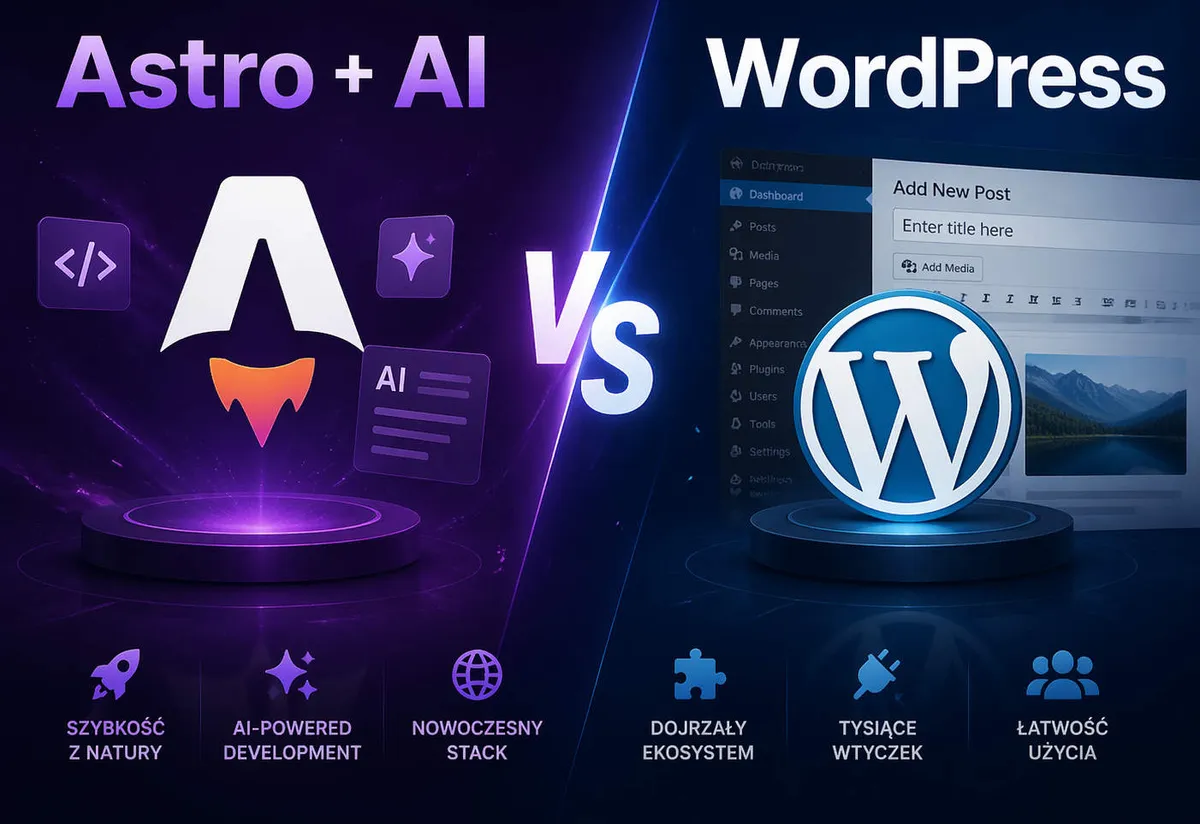
WordPress is still the default answer for a simple blog, and for good reason. It gives editors a familiar admin panel, a mature publishing flow, a huge plugin ecosystem, and a low barrier to entry for non-technical teams. If the goal is to launch quickly and hand off content operations without much custom thinking, WordPress remains a strong choice.
But the default answer is not always the best answer.
For a simple expert blog, the real question is no longer just “Which CMS is easier?” It is closer to this: what kind of publishing workflow does this site actually need, and how much system is justified by the scope of the content? That question matters more now because AI changes part of the equation. It does not replace a CMS, but it can reduce the operational cost of not having one.
That is the context behind StackCompass: a content site focused on technical decisions, not a newsroom, not a multi-author media operation, and not a marketing platform with dozens of moving parts. In that kind of setup, Astro starts to look less like a developer-first alternative and more like a rational publishing choice.
WordPress Still Solves a Real Problem
It is easy to dismiss WordPress by comparing its weakest implementations to the cleanest static-site demos. That comparison is unfair. WordPress continues to win because it solves a real operational problem: it gives non-technical people a complete editorial surface out of the box.
That includes a visual or semi-visual editing experience, media management, previews, scheduling, roles, revisions, and an interface most content teams already understand. For many organizations, that matters more than technical elegance. A system that is slightly heavier in architecture but much lighter in daily use can still be the better decision.
This is why WordPress remains a sensible choice for many simple sites. It is not only a CMS. It is a workflow product.
The wider PHP ecosystem keeps proposing alternative admin surfaces too - an open-source modular administration panel (PHP 8.1+, e-commerce and SEO modules) is a separate signal from the WordPress core line, but it competes for the same “single place to run the site” story.
A Simple Expert Blog Has Different Needs
Not every content site needs that level of editorial infrastructure.
A blog like StackCompass has a narrower job to do. The content model is simple. The number of templates is limited. The publishing cadence is moderate. There is no need for comments, user accounts, complex permissions, campaign landing pages, or an ever-expanding plugin stack. The value of the site comes from the clarity of the writing, the consistency of publishing, and the quality of the decisions behind the content structure.
That changes the decision.
When the site is primarily a focused publishing surface for expert articles, a traditional CMS can become more system than the project actually needs. In those cases, the question is not whether WordPress works. It clearly does. The question is whether it introduces more moving parts than the content operation justifies.
Where Astro Starts at a Disadvantage
Astro does not win by default. In fact, if we compare the out-of-the-box editorial experience, it starts from a weaker position.
Astro does not give a classic admin panel. It does not automatically solve editor onboarding, media workflows, preview expectations, or publishing comfort for non-technical users. A plain Astro setup can be elegant for developers and awkward for everyone else. If that is where the implementation stops, WordPress remains the more practical tool.
This is the point that often gets lost in framework-driven discussions. The real competitor to WordPress is not Astro alone. It is Astro plus the workflow built around it.
That workflow might include a git-based CMS, structured frontmatter, simple content collections, a preview environment, basic automation, and clear editorial rules. Without those pieces, replacing WordPress is mostly wishful thinking.
What AI Actually Changes
AI does not magically turn Astro into a CMS. What it does is reduce the friction around tasks that used to justify a fuller editorial system.
For a simple content site, a large share of the work is not publishing infrastructure in the strict sense. It is drafting, structuring, rewriting, summarizing, generating metadata, improving headings, tightening introductions, suggesting tags, refining excerpts, and preparing content for distribution. These are exactly the areas where AI can be useful.
That matters because it shifts some value away from the admin panel and toward the workflow surrounding the content.
If an editor can start from a structured prompt, get help drafting or polishing an article, generate a usable meta description, produce an excerpt, suggest internal linking opportunities, and standardize the article structure before publication, then some of the practical advantage of a classic CMS becomes less decisive. The team still needs a place to publish, but it may no longer need a heavy system to support every editorial step.
In that sense, AI does not replace WordPress. It lowers the cost of operating without WordPress.
The Real Comparison Is Workflow vs Workflow
This is the most important reframing.
The meaningful comparison is not WordPress versus Astro as abstract technologies. It is one publishing workflow versus another.
A WordPress workflow typically looks like this: log in, draft inside the CMS, upload assets, adjust SEO fields, preview, publish, and iterate from the same interface. Its strength is consolidation. Most editorial tasks happen in one place.
An Astro-based workflow looks different. Drafting may begin outside the site itself. Content may live in Markdown. Editing may happen through a git-based editorial layer, while teams on classic PHP stacks still live inside full CMS products - Joomla 6.1 is one recent example of how those products keep deepening workflows (CAPTCHA, visual workflow editing, richer media fields). Preview may be handled via deploy previews rather than a classic live preview. AI may assist with structure, metadata, titles, and summaries before the article is committed. Its strength is not consolidation but simplicity: fewer runtime dependencies, fewer layers in production, and more control over the final output.
For a content-heavy marketing organization, the WordPress model often remains superior. For a small expert blog, the Astro model can be surprisingly efficient once the workflow is intentionally designed.
When Astro + AI Makes Sense
This combination starts to make sense under a specific set of conditions.
First, the content model must stay simple. A blog with a title, description, date, tags, cover image, and body is a very different problem from a site with many custom content types and editorial dependencies.
Second, the number of editors should be small. If one person or a small team owns the publishing flow, a lighter stack is easier to keep coherent.
Third, the site should value performance, portability, and low runtime complexity. The “outer loop” still depends on developer environments - DDEV’s latest TYPO3-oriented updates (tunneling, dashboards, container options) are a reminder of that. A file-first Astro content pipeline is not automatically the right answer for every surface, but it is a good fit when the content does not require dynamic application behavior.
Fourth, the team must be comfortable replacing some built-in CMS convenience with process discipline. That does not mean making editors use Git directly. It means designing a workflow that is intentionally simple rather than passively convenient.
Fifth, AI should be used as assistance, not as a substitute for editorial judgment. The quality of the blog still depends on the clarity of thought, not on how quickly text appears on the screen.
A site like StackCompass fits these conditions well. It does not need the operational surface area of a traditional CMS. It needs a reliable way to publish focused, well-structured articles with low friction and high control.
When WordPress Still Wins
There are still many scenarios where WordPress is the better decision.
If a site has many editors, many publishing roles, frequent updates, campaign-driven pages, complex editorial approvals, or a strong need for plugin-based flexibility, WordPress usually keeps its advantage. The same is true when the client or content team expects a traditional admin experience and wants independence from developer-owned workflows.
WordPress also wins when the organization benefits more from standardization than from technical restraint. In some teams, the biggest risk is not performance or complexity in production. It is editorial confusion. A familiar CMS can reduce that risk far more than a custom lightweight setup.
This is why Astro should not be presented as a universal replacement. In many environments, it is not one.
Why This Matters for StackCompass
StackCompass is a good example of where the trade-off changes.
It is a focused blog with a clear editorial angle: content architecture, CMS choices, and technical decision-making. It does not need a complicated backend. It does not need plugin-heavy extensibility. It does not need to behave like a digital magazine. It needs to publish strong articles consistently, distribute them through channels like RSS, and keep the publishing overhead low.
In that context, Astro aligns well with the product itself. It keeps the site fast, small, and deliberate. A git-based editing layer can cover the publishing surface. AI can assist with drafts, summaries, excerpts, meta descriptions, and structural cleanup. The result is not a richer CMS. It is a leaner publishing operation.
That is the relevant advantage.
Conclusion
AI does not make WordPress obsolete. It does something more subtle and more interesting: it changes the threshold at which a traditional CMS is necessary.
For simple content sites, especially expert blogs with a narrow scope and a small editorial operation, Astro plus a well-designed workflow can now compete with WordPress more seriously than before. Not because Astro suddenly offers the same editorial surface, but because AI can reduce some of the friction that once made a classic CMS the obvious choice.
The better question, then, is not whether Astro can replace WordPress in general.
It is whether WordPress is still solving enough of the right problems for this specific site to justify its weight.
For StackCompass, the answer may be no. And that is precisely what makes the decision worth examining.